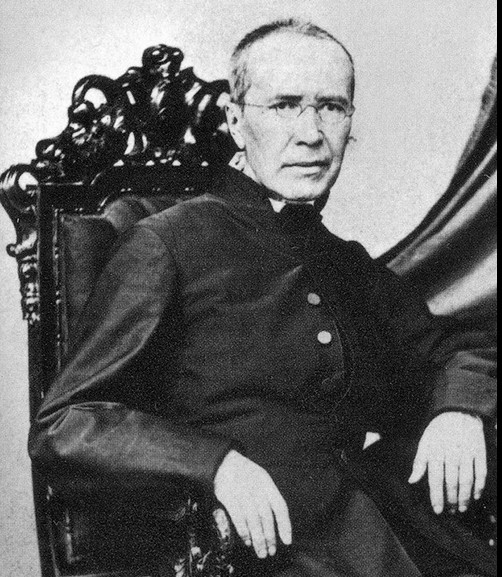
 Name: Saint Cyr, Jean Marie Irenaeus
Born: 11/02/1803
Place Quincie, Beau jeu
Ordained: 04/06/1833
Place Ordained: St. Louis, Missouri
Years of Service: 1833-1837
Died: 02/21/1883
Place Died: Lemay, Missouri
Burial Info: Nazareth Convent/of the Sisters of St Joseph of Carondelet – Lemay MO
(See Note below about relocation of cemetery)
PLEASE NOTE THIS UPDATE:
NAZARETH CEMETERY of the Sisters of St. Joseph of Carondelet, founded in 1874 and originally located on the grounds of Nazareth Nursing Home in Mehlville, MO, has been relocated to RESURRECTION CEMETERY in Southwest St. Louis County, which is owned by the Archdiocese of St. Louis.
Nearly 1,200 graves of the pioneer members of the Sisters of St. Joseph of Carondelet were relocated. Space for the projected future burial needs of deceased CSJ sisters in the region has also been provided on the new burial lot. There are also three inscribed upright cenotaphs to commemorate Sisters who have donated their remains to medical science erected on the Sisters’ burial lot.
The three priest chaplains buried in the original Nazareth cemetery (once very distant from the City of St. Louis) were relocated to the Old Priests’ Lot at Calvary Cemetery in North St. Louis.
New monuments have been erected on the new Sisters’ Lot at Resurrection Cemetery, followed by a commemoration service and blessing of the lot. The grave relocation had been completed as of Sept. 2009. Portions of statuary and memorial work from the original Nazareth Cemetery were also incorporated into the design of the new lot.
Other relocated nuns’ burial lots from other religious orders’ former private cemeteries have also been relocated to this section of Resurrection Cemetery.
The new CSJ Sisters lot is platted for future burials from the Sisters of St. Joseph of Carondelet, which are now taking place there as well as well as at their 1880’s burial lot at Calvary Cemetery.
Notes: John Mary Irenaeus St. Cyr (1803–1880) was a French-born Roman Catholic priest, ordained in 1833, who served as the first resident pastor in Chicago, arriving in May 1833. He established St. Mary’s, the first Catholic parish in the city, before later moving to serve communities in Missouri.
Key details regarding Fr. John Mary Irenaeus St. Cyr:
Mission to Chicago: Bishop Joseph Rosati of St. Louis sent him to Chicago in response to a petition from local Catholics, arriving on May 1, 1833.
Establishment of Faith: He built the first Catholic church in Chicago, a small log cabin named St. Mary’s, situated near present-day State and Lake Streets.
Ministry: He served the Chicago area until 1837 before continuing his ministry in other parts of the Diocese of St. Louis.
Documentation: Papers relating to his work, including a one-page document from 1880, are preserved in Chicago collections.
On April 16, 1833, Bishop Joseph Rosati of St. Louis whose farflung diocese included most of the American Midwest, received a petition from Catholics living in Chicago asking that he send a resident priest to minister to them. The petition to Rosati was signed by 36 men and listed the number of family members belonging to each, for a total of 128 Catholic individuals.
Judging by their last names, the petitioners numbered 21 French, 13 Scottish or English and two Irish. Many of the signers had Indian blood or were married to Indian women.
The petition was written in French. Chicago incorporated as a town that same year, on June 18. A minimum of 150 settlers was required for incorporation. If the minimum number were present in Chicago, the 128 Catholics would have comprised an overwhelming majority. Even if more Chicagoans were present in 1833, as some historians have estimated, Catholics formed a significant presence in the new town.
Bishop Rosati responded to the Chicago petition immediately and sent a newly ordained, French-born priest, John Mary Irenaeus St. Cyr. Arriving in Chicago on May 1, 1833, he said Mass for the first time in Mark Beaubien’s log cabin.
St. Cyr and his eager flock formed St. Mary’s parish and quickly built a wooden church building at the corner of Lake and State streets. St. Mary’s church was one of the first buildings in the United States built by the so-called “balloon-frame” method. Instead of employing skilled carpenters to laboriously fit together heavy wooden beams with mortises and tenons, a light-weight frame was hastily assembled from pine boards and nailed together.
The balloon frame was cheaper and quicker to erect and so easier to break down again or move intact. Accordingly, St. Mary’s church migrated twice, first to Michigan and Madison and then to Wabash and Madison.
St. Cyr ministered not only to his original flock of petitioners in Chicago but to about 400 others, including Indians and African-Americans, in the surrounding area.
In 1834, the Chicago area came under the jurisdiction of a newly formed diocese at Vincennes, Indiana, but St. Cyr remained for two more years until October 1836 when he returned to St. Louis and was replaced by a priest from Vincennes.
[https://www.chicagocatholic.com/chicagoland/-/article/2014/11/16/from-chicago-s-first-days-catholics-were-here]
Also see the Chicago Historical Museum:
https://explore.chicagocollections.org/marcxml/chicagohistory/30/s757z7f/